Walk down K Street or across Capitol Mall during rush hour and you will see the same thing every day: drivers rolling through crosswalks while people on foot are still finishing the crossing. California puts the duty to yield on the driver in every marked crosswalk and in the unmarked ones too, which exist at nearly every intersection whether anyone painted lines or not.
A pedestrian accident lawyer Sacramento CA residents call after a crash often hears the same story: a driver turning right on red, a driver checking a phone, a driver not looking before pulling into an intersection. Rawlins Law Accident & Injury Attorneys, a Sacramento car accident attorney team that reviews pedestrian claims individually, represents people struck while walking through downtown, Midtown, and neighborhoods across the region. Call 858-529-5872 for a free case review.
Experience the Ashley Advantage
Contact Us 24/7 for a Free Case Evaluation
Table of contents
- Downtown and Midtown Carry an Outsized Share of These Crashes
- What Does California Law Actually Say About Crosswalks?
- Does Crossing Mid-Block End Your Claim?
- Pedestrians Struck by Trucks and Delivery Vehicles
- Motorcyclists and Pedestrians Share the Same Exposure
- What Makes a Pedestrian Claim Take Longer to Value?
- Rawlins Law's Approach to Pedestrian Cases
- FAQs: Pedestrian Accident Lawyer Sacramento CA
- Speak With Our Sacramento Pedestrian Injury Team
Downtown and Midtown Carry an Outsized Share of These Crashes
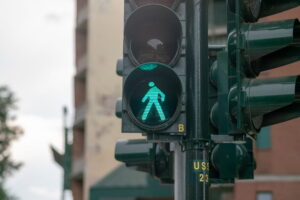
Sacramento's grid-pattern streets downtown and in Midtown put an enormous amount of foot traffic within a few blocks of fast-moving one-way streets. Events at Golden 1 Center and Downtown Commons draw crowds crossing multiple intersections at once, and the R Street corridor's mix of restaurants, converted warehouses, and light rail stops keeps sidewalks busy well past the evening commute. One-way streets like 16th and 19th move traffic quickly, and a driver focused on merging into the correct lane sometimes stops watching the crosswalk directly ahead.
The city's Vision Zero program has flagged downtown and Midtown corridors as priority areas for safety redesigns. That context matters in a pedestrian accident claim, since a documented history of dangerous conditions at a specific intersection can support an argument that a crash was foreseeable and preventable.
Weekend and evening crashes cluster around a different pattern than weekday rush hour. A driver leaving a downtown event or a Midtown restaurant late at night faces reduced visibility, while pedestrians cross outside the predictable commute-hour flow. Streetlight coverage varies block by block, and a poorly lit crosswalk near an entertainment venue creates real risk that has nothing to do with anything the pedestrian did wrong.
What Does California Law Actually Say About Crosswalks?
It puts the duty to yield on the driver, and it does not require paint. California Vehicle Code Section 21950 requires drivers to yield to pedestrians in any marked crosswalk and in any unmarked crosswalk at an intersection, which legally exists at nearly every corner where sidewalks meet. A pedestrian crossing at a plain residential intersection has the right-of-way under this statute.
The same section requires more than yielding. Subdivision (c) requires a driver approaching a pedestrian in a crosswalk to reduce speed or take whatever other action is needed to safeguard that person's safety. That is a higher duty than simply not hitting someone, and it is often the provision that decides a contested claim.
That right-of-way is not unlimited. Section 21950 also requires pedestrians to use due care and not leave a curb suddenly into the path of a vehicle so close that it cannot stop. If you are unsure which side of that line your crossing fell on, call 858-529-5872 and we will look at it with you.
Does Crossing Mid-Block End Your Claim?
No. Mid-block crossings work differently under California Vehicle Code Section 21954, which puts the yielding duty on the pedestrian rather than the driver. Subdivision (b) of that same section says in plain terms that it does not relieve a driver of the duty to exercise due care for the safety of any pedestrian on the roadway.
The word "jaywalking" gets used as though it settles the question, and it does not. California's comparative negligence rule means a recovery is reduced by the share of fault assigned to you rather than eliminated. A driver who was speeding, distracted, or failed to see someone already committed to a crossing can still carry the larger share.
Worth knowing: Section 21954 now limits when an officer may stop a pedestrian for crossing outside a crosswalk at all, requiring an immediate danger of collision before a citation. That limit governs enforcement on the street, not fault in a civil claim, and the two are often confused. This is where a hit by car while walking Sacramento case gets decided long before a courtroom, through traffic camera footage, nearby business surveillance, and witness accounts that establish how much time a driver actually had to react.
Pedestrians Struck by Trucks and Delivery Vehicles
Downtown Sacramento's dense mix of retail, restaurants, and office towers means constant delivery and freight activity sharing narrow streets with foot traffic. Cases involving pedestrians hit by trucks in Sacramento tend to produce larger claims than a passenger vehicle collision. A delivery van backing out of a loading zone on a crowded block, or a box truck turning without checking a blind spot, can reach a pedestrian with almost no warning.
These cases also open more potential sources of recovery. A delivery company, a contracted driver, and sometimes a separate logistics provider can all carry liability, and commercial policies typically carry higher limits than a personal auto policy. Sorting out which entity employed the driver at the time, and which policy applies, takes longer than a standard pedestrian case and can change what the claim is worth.
Loading zones create their own predictable danger pattern. A truck double-parked with hazards on, unloading onto a sidewalk, forces pedestrians to step around the vehicle and sometimes into the traffic lane. When that improvised detour puts someone in a driver's path, the loading company and the vehicle's owner can both come under scrutiny for how the unloading was managed.
Motorcyclists and Pedestrians Share the Same Exposure
Both groups meet the same driver mistake and get treated the same way by the law. Motorcyclists and pedestrians injured in Sacramento frequently deal with an identical error, a left turn made without checking oncoming traffic or a lane change without a mirror check, producing a different claim only because of who happened to be in the intersection.
That matters because the legal standard does not shift with the mode of travel. A driver's duty to look before turning or changing lanes applies the same way whether the person in the intersection is on foot or on two wheels. A visibility argument raised against a pedestrian is the same argument raised against a rider, and it answers the same way, with sightline distances and speed data rather than assumptions.
Intersections that see repeated motorcycle crashes tend to see pedestrian crashes too. That history is documentation, and a corner with a record of prior collisions is a different piece of evidence from a corner without one.
What Makes a Pedestrian Claim Take Longer to Value?
A pedestrian absorbs a collision directly, with no vehicle structure in between, so the claim is usually larger and slower to become clear than a two-vehicle case. A Sacramento pedestrian injury attorney working one of these files is building toward a number that will not be knowable for months.
Settling before the treating physicians can describe long-term limitations tends to undervalue the claim, and a settlement cannot be reopened. The file is built on treatment records, consistent follow-up care, and a documented account of what the person can and cannot do now compared with before.
Vocational impact gets overlooked in the early weeks. A pedestrian whose job requires standing, walking, or driving can face a much longer road back to full earning capacity than the initial discharge paperwork suggests, and that gap is exactly where a first insurance offer falls short. Most Sacramento pedestrian injury lawsuits must be filed within two years of the crash under California Code of Civil Procedure Section 335.1, and a claim against a government entity over a dangerous roadway condition generally requires a formal claim within six months under Government Code Section 911.2.
Rawlins Law's Approach to Pedestrian Cases
Ashley Rawlins, also known as Car Crash Ash, built Rawlins Law around individual case review, and pedestrian cases benefit from that more than most, since fault gets contested harder here than in a typical two-vehicle crash. We are a female-owned firm, we stay personally involved from intake through resolution, and we take on cases other offices decline over disputed liability or partial fault.
Our Sacramento office at 500 Capitol Mall, Suite 2350, sits close to many of the intersections where these crashes happen. We negotiate professionally and with full documentation, and we prepare every claim as though it may need to be tried in Sacramento County Superior Court. Every pedestrian case starts with a detailed review of the intersection itself, not just the police report.
Sightlines, signal timing, and lighting conditions all factor into how a case gets built, and knowing a specific Sacramento corner the way a longtime local does matters more here than in a rear-end collision. We apply no minimum case value, so a claim another office turned down over partial fault still gets a real review. Call 858-529-5872 to talk through what happened at your intersection.
FAQs: Pedestrian Accident Lawyer Sacramento CA
These are the questions Sacramento pedestrians ask most often in the first call after a crash.
I was crossing mid-block when I got hit. Do I still have a case?
Often, yes. Mid-block crossings shift some duty to the pedestrian under Section 21954, but that same section preserves the driver's duty of due care. A driver who was speeding, distracted, or had clear time to stop can still carry most of the fault, with your recovery reduced by your share rather than erased.
The driver said the sun was in their eyes. Does that excuse them?
Not automatically. Drivers are expected to adjust for known conditions like glare, and failing to slow down or lower a visor can itself be negligence. Section 21950 requires a driver approaching a crosswalk to reduce speed as needed for a pedestrian's safety, which is hard to square with driving blind into one.
Will my case be affected if I do not remember the crash clearly?
Not necessarily. Traffic cameras, nearby business footage, police reports, and witness statements often reconstruct a crash more reliably than anyone's memory of it. Gaps in recall are common after a serious collision and are not treated as a weakness in the claim, provided the other evidence is gathered quickly.
What if the driver who hit me fled the scene?
Uninsured motorist coverage on your own auto policy, or on a resident relative's policy, often covers a hit-and-run even though you were on foot. If nobody in your household carries auto insurance, tell us early, because the options narrow and we will work the identification angle with law enforcement.
Can I bring a claim if the crash happened in a parking lot rather than a street?
Yes. A driver owes a duty of care to pedestrians on private property, and a parking lot owner can carry separate responsibility for layout, signage, or lighting that made the area unsafe. The Vehicle Code right-of-way rules apply differently there, so these claims get built on ordinary negligence instead.
How soon after a pedestrian accident lawyer Sacramento CA firm gets involved does anything happen?
We typically begin gathering evidence and notifying insurers within days. Surveillance footage from nearby businesses is often overwritten within a week or two, and physical evidence at the intersection does not survive the next rain, so the preservation requests go out before anything else.
Does it cost anything to talk with Rawlins Law about a pedestrian injury case?
No. Consultations are free, and we work on contingency, which means our fee is a percentage of what we recover and comes out of that recovery rather than out of your pocket. If we recover nothing on your behalf, you owe us no attorney fee.
Speak With Our Sacramento Pedestrian Injury Team

Being struck while walking can mean months away from work and a long recovery, and California law puts responsibility on the driver who failed to yield. Rawlins Law reviews every Sacramento pedestrian case individually, gathers evidence before it disappears, and stays personally involved from your first call onward. There is no charge to find out where you stand.
Call 858-529-5872 or visit our office at 500 Capitol Mall, Suite 2350, for a free case review. We will tell you honestly how the fault question looks and what the claim involves.


